OpenMOSS Research

MOSS-VL-Realtime

The world has no progress bar.It does not pause, cannot rewind, and waits for no one.

Yet, the default paradigm of video models remains offline: AI acts like an observer watching a recording after the fact, waiting for the world to end before answering; once answering, it turns a blind eye to newly unfolding events. This "watch first, answer later" mode works well for post-game analysis, but is sluggish in a real world where every second counts.

We believe that when AI truly steps into the physical world, it must live in the "present continuous tense".We want to equip the model with the ability to handle real-world pacing: judging when to speak, instantly responding to sudden events, quietly observing when information is scarce, and even correcting itself mid-sentence when the scene flips.

Today, we open-source MOSS-VL-Realtime:An 11B open-weights streaming video understanding model. This is not just a new tech release, but our answer to breaking this "time barrier".

Our goal is simple: shift video understanding entirely from "watching recordings" to "watching live". Watching and answering are no longer sequential; answers are generated and corrected while watching. Every token chooses between speaking and silence. We hope to finally align AI with the physical world, inviting the community to explore the next step of multimodal interaction in an open-source way.

Core Interaction Paradigm

To equip the model with the ability to handle real-world pacing like a human, we discarded traditional per-second polling and external schedulers, directly instilling MOSS-VL-Realtime with three core behaviors:

Anytime Response

Breaking the latency of "watch first, answer later".Users can ask at any second, and the model instantly responds based on the current frame.

Proactive Silence

"letting the bullet fly".Independently remaining silent and waiting when information is insufficient or no key events occur.

Timely Correction

Cognition updates dynamically with the scene.Instantly adjusting and correcting previous answers as new frames flow in.

These three natural interactions stem from a single underlying design: video frames, user questions, and model answers are aligned into a single token stream. Dialogue occurs amidst continuously flowing frames, and questions act like "live chat", seamlessly inserted at any point in the timeline.

Figure 1 illustrates how this unified and interleaved streaming input sequence operates under the hood.

Auto loop · Move mouse left/right on film strip = progress bar(Pause freezes, drag back rewinds) · Hover below: A & B column matches highlight
A · HUMAN VIEW watching and speaking happen at the same time CAMERA / WORLD 0.0s 1.2s 2.3s1 3.5s3⚡ a third person enters 4.6s USER "How many people are in the room?" 2 MODEL "Two people" "now three." the answer keeps running while frames keep arriving — and changes course when the scene does B · MODEL VIEW one interleaved token sequence system ▸ ··· <|im_start|>assistant <|silence|> ··· <|vision_start|><|time_start|>2.3 s<|time_end|><|vision_end|>1 <|silence|> <|im_end|> <|im_start|>user How many people are in the room?2 <|im_end|> <|im_start|>assistant a question can arrive at any moment — the open turn is closed, a new one is spliced in Two people <|vision_start|><|time_start|>3.5 s<|time_end|><|vision_end|>3 now three. ··· a new frame lands inside the running answer — the next tokens change course vision tokens — frame + absolute timestamp <|silence|> — explicit idle token generated answer turn structure user text

Figure 1: Streaming input representation mechanism.Top (Column A) represents human intuitive perception: watching and answering are parallel, instantly correcting when scenes change. Bottom (Column B) represents actual sequence representation: the interaction is encoded as an interleaved token sequence, embedding absolute-timestamped frames into open turns. Questions append anytime, and <|silence|> acts as an explicit silence token in decision-making.

Architecture & Spatiotemporal Representation

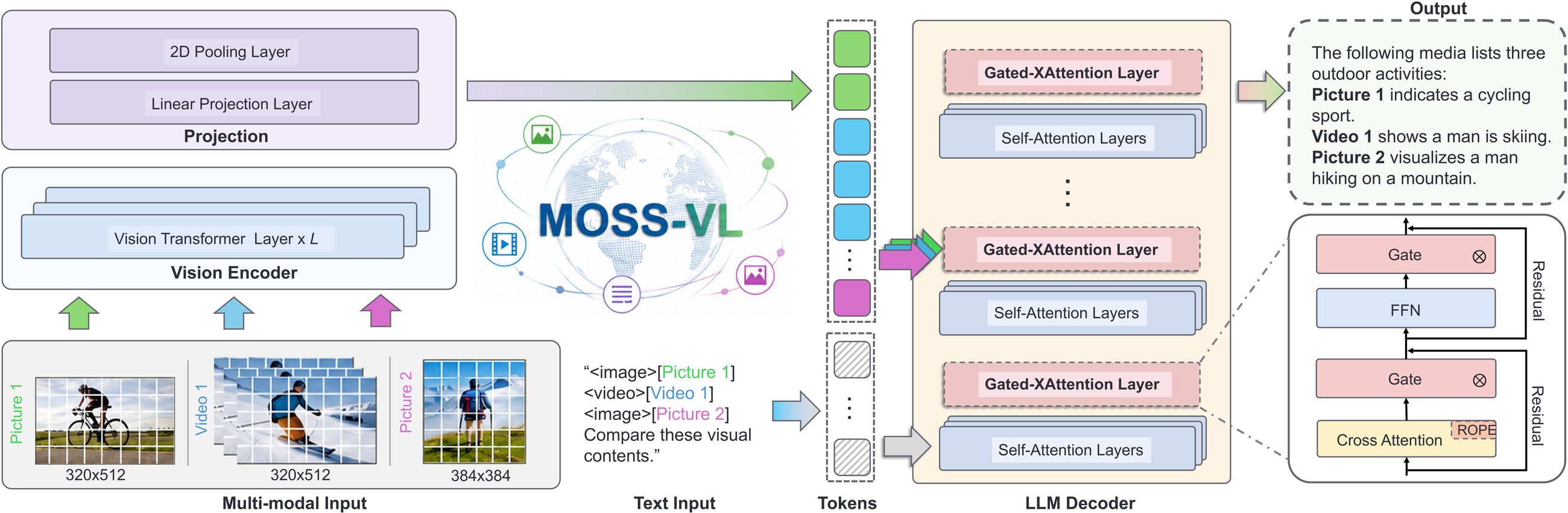
The architecture of MOSS-VL-Realtime is specifically designed for long-context streaming video understanding. Core components include:

MOSS-VL-Realtime Architecture
Figure 2: MOSS-VL-Realtime architecture. Shows the decoupled cross-attention and spatiotemporal representations, supporting audio-visual inputs in a unified feature space.

This interaction and spatiotemporal modeling capability stems not only from a rational architecture but from a comprehensive rebuild of multimodal corpora. We introduced a new streaming SFT interaction training paradigm, enabling the model to precisely predict when to speak or proactively stay silent at any moment of sequence generation.


Monitoring & Alerts

DEMO 01Snowy street surveillance. Maintains realistic silence when nothing happens, and instantly alerts the moment the target person falls.

DEMO 02Watches for one agreed-upon event only: the moment the cat touches the carrot it says “nice!”, and stays silent the rest of the time.

Live Commentary & Presentation

DEMO 03Live broadcast a football match with professional TV commentary tone; passes, shots, and goals are captured and called instantly.

DEMO 04Delivers an impromptu talk over a slide deck, picking up each page the moment it appears and carrying the talk from opening to close.

Time & Number Sense

DEMO 05Catches every successful shot and calls out the running count in real time.

DEMO 06Observe the pea growth timelapse, capture key changes, and accurately report the day they occurred.

DEMO 07Watches a hand solving the problem and transcribes each new line of formula as soon as it is written.

Interactive Reading & Feedback

DEMO 08Plays a palm-reading master: waits until the palm is clearly visible, then reads the lines one by one while observing.

DEMO 09Comments on the outfit in front of the camera; when the user returns in new clothes, it notices the change at once and continues with advice for the new look.


Model Performance

MOSS-VL-Realtime demonstrates significantly stronger streaming interaction, reaching open-source SOTA on streaming video understanding benchmarks while delivering more reliable, real-time responses on complex dynamic tasks.

At the core interaction level, the model stays in sync with the physical world through industry-leading proactive speaking — independently and precisely deciding when to speak and when to stay silent.

Meanwhile, its streaming perception, spatiotemporal grounding, and long-context capabilities keep strengthening: facing sudden events and scene reversals, the model always corrects itself instantly.

Built on these breakthroughs, the model achieves open-source SOTA results across multiple streaming benchmarks, keeps pushing the boundary of seamless streaming interaction, and understands temporal changes, key actions, and sudden events with unprecedented sharpness.

Streaming VLM must not only understand "content" but precisely judge "timing". To fully evaluate MOSS-VL-Realtime's real-time inference capabilities, we conducted an in-depth evaluation on four core benchmarks. The figure below breaks every benchmark down subset by subset for a full side-by-side comparison.

Offline Foundation

During this iteration, we systematically refactored and deeply optimized the data system, solidifying a powerful foundation of fundamental capabilities. Thanks to this, the co-generation Instruct model not only maintains a highly robust benchmark profile in offline capabilities, but also achieves significant improvements in fine-grained multimodal perception (V*Bench 89.0, BLINK 78.0) and high-difficulty temporal action grounding tasks. It continues to deliver remarkably stable performance in long-context video understanding (VideoMME, MLVU) and complex document and chart analysis (DocVQA, ChartQA), comprehensively aligning with or even leading top-tier open-source baselines of comparable scale.

Citation

@misc{mossvlrealtime2026,
  title  = {MOSS-VL-Realtime},
  author = {OpenMOSS Team},
  year   = {2026}
}