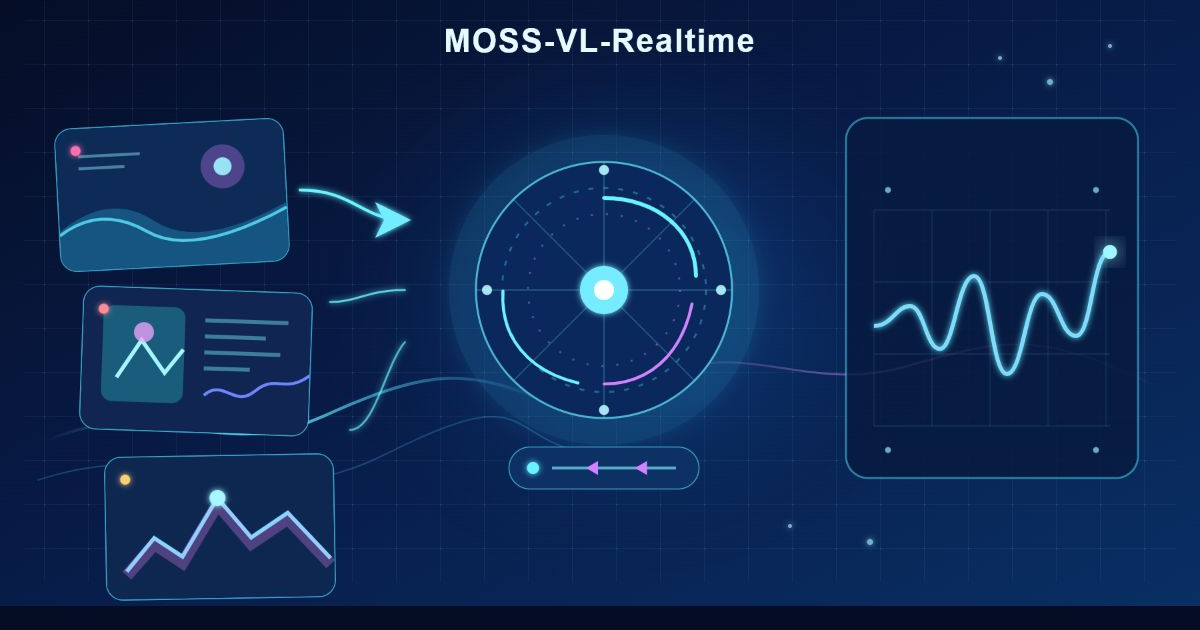
Short answer: MOSS-VL is OpenMOSS’s open-weight vision-language model family. MOSS-VL-Realtime is designed for continuous video streams: it consumes timestamped frames incrementally, accepts questions at any moment, can stay silent when context is insufficient, and updates an earlier answer when the scene changes.
MOSS-VL-Realtime
Real-time interaction over cameras, screens, live streams, and continuous video sources.
MOSS-VL-Instruct-0708
Offline image/video understanding, long-video analysis, and deep dialogue.
MOSS-VL-Base-0708
An open foundation for continued pre-training, SFT, and LoRA adaptation.
Shared scale
All three current models are 11B with a 256K context and are available through Hugging Face and ModelScope.
What makes real-time video different?
Offline video QA can wait for the full recording. A camera assistant, robot, screen monitor, or live production tool cannot. MOSS-VL-Realtime treats the video timeline as an active input: visual perception and text generation run together, new questions can arrive while frames continue to stream, and the model can decide whether an event deserves a response.
Architecture in three ideas
Cross-Attention separates visual encoding from language reasoning for dynamic streams and interleaved image/video/text input. Absolute timestamps anchor every sampled frame to a precise point in time. XRoPE maps text tokens and video patches into a shared (t, h, w) space for fine-grained temporal and spatial grounding.
The project README reports leading results on the proactive evaluations of OmniMMI, StreamingBench, and ProactiveVideoQA. Those claims should be read together with the official technical blog and paper; the comparison below is a positioning guide, not a single cross-model leaderboard.
How does MOSS-VL compare with well-known models?
| Model / family | Primary positioning | Continuous stream | Weights and fine-tuning | Choose it when… |
|---|---|---|---|---|
| MOSS-VL | Real-time video + offline long video + open base | Native goal: incremental frames, proactive silence, dynamic correction | Open weights; Base, SFT, LoRA, and SGLang paths | You want an open model built around “watch while answering” |
| GPT-4o | Closed general-purpose multimodal assistant | Depends on product/API integration | Hosted API; no downloadable weights | You prefer a managed general multimodal service |
| Gemini 2.5 Pro | Closed long-context multimodal model | Service-defined multimodal input and deployment boundary | Hosted API; no downloadable weights | You need a managed long-context model |
| Qwen2.5-VL | Open image/video understanding and VQA | Streaming requires application-level scheduling | Open weights; local deployment and fine-tuning | You need a strong open offline VLM baseline |
| InternVL3 | Open large-scale vision-language family | Usually needs application-level stream/state management | Open research ecosystem | You care about high-resolution VLM research |
| LLaVA-OneVision | Open vision-instruction community baseline | Sampling, caching, and scheduling live in the application | Open ecosystem for experiments | You need a widely used vision-instruction baseline |
In other words, GPT-4o and Gemini 2.5 Pro are hosted reference points; Qwen2.5-VL, InternVL3, and LLaVA-OneVision are open VLM reference points; MOSS-VL’s distinctive bet is to make continuous video interaction a first-class model objective while keeping offline and fine-tuning variants in the same family.
Quick start
conda create -n moss_vl python=3.12 pip -y
conda activate moss_vl
pip install -i https://pypi.org/simple --no-build-isolation -r requirements.txt

CUDA_VISIBLE_DEVICES=0 python realtime_inference/run_online_inference.py \
  --checkpoint OpenMOSS-Team/MOSS-VL-Realtime \
  --source video --video path/to/example.mp4 \
  --sample-fps 1 --playback-speed 1 --max-frames 256
Use model.create_realtime_session(...) for direct frame/prompt/output control, model.online_generate(...) for queue-based workers, or --serve for a FastAPI WebSocket service.
Resources
- GitHub: OpenMOSS/MOSS-VL · Hugging Face · ModelScope
- Paper · Technical blog · Apache-2.0 License
- Reference projects: Qwen2.5-VL, InternVL, LLaVA-OneVision, GPT-4o, and Gemini.
Star OpenMOSS/MOSS-VL if you are building or studying real-time video understanding.