Real conversations include pauses, brief acknowledgments, changes of plan, and voices that are not addressed to the assistant. A system participating in that conversation has to decide when to keep speaking, when to wait, and when to yield the floor.
MOSS-Live puts these interaction decisions at the center of its design. In the evaluation charts published by MOSS, it leads all six reported full-duplex metrics across the compared models. Against GPT-Live-1 and Doubao SeedDuplex, the largest gaps concern irrelevant speech and interruption handling. Tool use and multi-turn task completion show a more mixed picture.
Reported full-duplex metrics led by MOSS-Live across the models in the source charts.
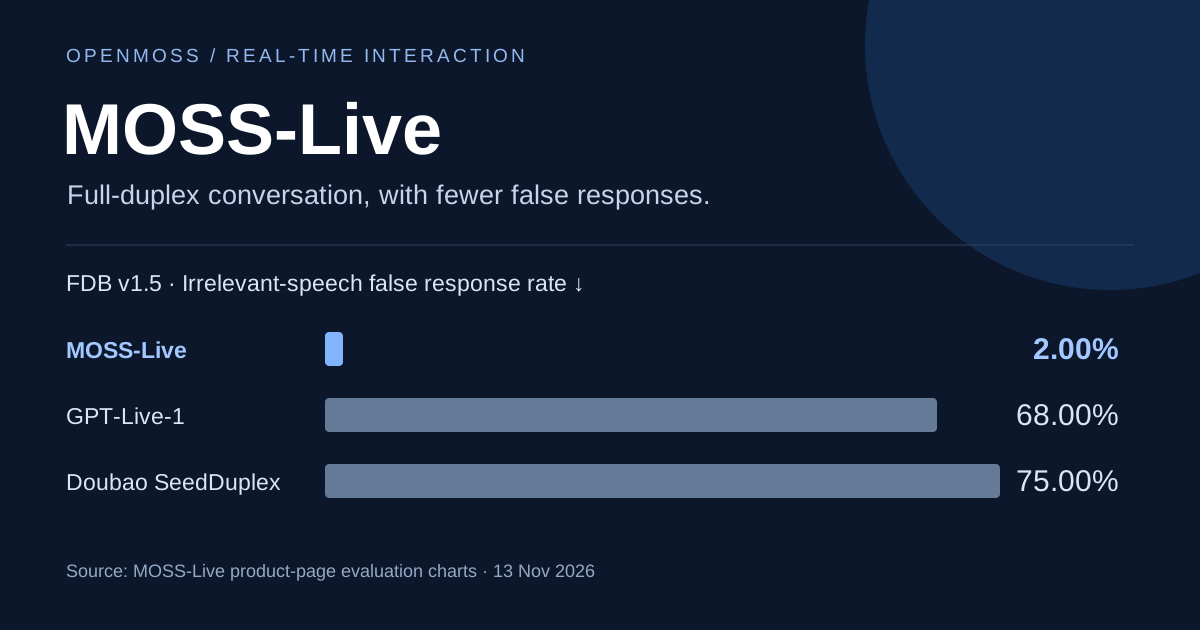
False responses to irrelevant speech, versus 68% for GPT-Live-1 and 75% for Doubao.
Premature responses during pauses, versus 10.37% for GPT-Live-1 and 14.29% for Doubao.
How does it compare with GPT-Live and Doubao?
The tables retain the exact model labels used in the source charts: GPT-Live-1, Doubao SeedDuplex, and GPT Realtime 2.1. These labels identify the evaluated systems; results should not be generalized to every version in a product family. Lower is better for ↓ and higher is better for ↑. Bold marks the best value in each row, including ties.
Full duplex: fewer premature responses and unwanted interruptions
| Benchmark / metric | MOSS-Live | GPT-Live-1 | Doubao SeedDuplex | GPT Realtime 2.1 |
|---|---|---|---|---|
| FDB v1 Premature response during pauses (excluding backchannels) ↓ | 1.44% | 10.37% | 14.29% | 3.83% |
| FDB v1.5 False responses to irrelevant speech ↓ | 2.00% | 68.00% | 75.00% | 72.00% |
| FDB v1.5 Rejection of irrelevant interruptions ↑ | 68.00% | 21.00% | 13.00% | 5.00% |
| τ-Voice Robustness to backchannels ↑ | 98.17% | 91.57% | 93.52% | 56.26% |
| τ-Voice Robustness to verbal fillers ↑ | 82.16% | 48.48% | 69.66% | 57.75% |
| τ-Voice Robustness to irrelevant speech ↑ | 78.90% | 66.99% | 60.42% | 27.10% |
Source: the MOSS-Live full-duplex evaluation chart. It also includes Qwen Audio 3.0 Plus and Flash; MOSS-Live leads those models on all six metrics as well. English metric labels are translations of the source chart.
False responses to irrelevant speech show the largest separation: MOSS-Live scores 2%, which is 66 percentage points below GPT-Live-1 and 73 points below Doubao. Its premature-response rate during pauses is lower by 8.93 and 12.85 points, respectively. These metrics address two distinct failures: speaking before the user has finished thinking, and responding to speech intended for someone else.
Interference during a response is another test. MOSS-Live rejects 68% of irrelevant interruptions, compared with 21% for GPT-Live-1 and 13% for Doubao. Its robustness to backchannels reaches 98.17%. Together, these results suggest better control of conversational timing in the evaluated settings: preserving a response through an acknowledgment or unrelated sound while remaining receptive to meaningful input.
Tools and tasks: a tie in tool calling, a remaining task-completion gap
| Benchmark / metric | MOSS-Live | GPT-Live-1 | Doubao SeedDuplex | GPT Realtime 2.1 |
|---|---|---|---|---|
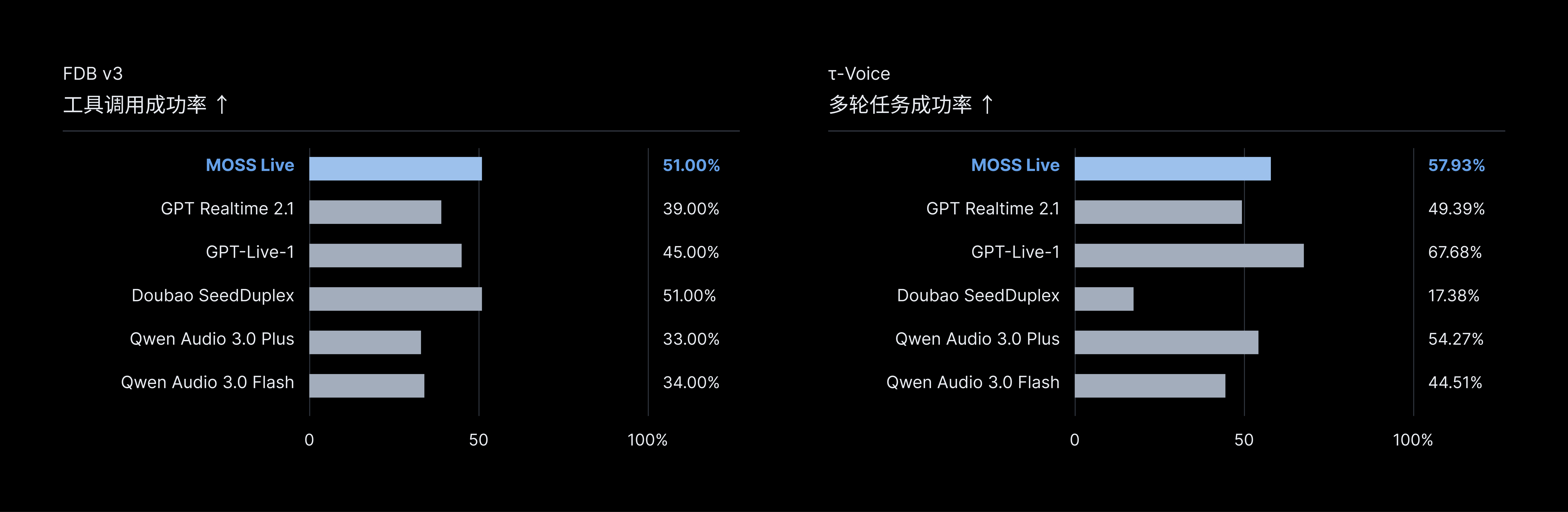
| FDB v3 Tool-calling success ↑ | 51.00% | 45.00% | 51.00% | 39.00% |
| τ-Voice Multi-turn task success ↑ | 57.93% | 67.68% | 17.38% | 49.39% |
MOSS-Live achieves 51% tool-calling success on FDB v3, above GPT-Live-1 at 45% and tied with Doubao for the highest reported result. On τ-Voice multi-turn tasks, it reaches 57.93%: 40.55 percentage points above Doubao and second among the six models in the chart. GPT-Live-1 leads at 67.68%, leaving a 9.75-point gap.
Conversational fluency and task completion need separate checks. MOSS-Live has a clear advantage on the reported full-duplex metrics; GPT-Live-1 remains stronger on this multi-turn task-completion measure.
Understanding and continuity: strengths after interruption, with tradeoffs
| Benchmark / metric | MOSS-Live | GPT-Live-1 | Doubao SeedDuplex | GPT Realtime 2.1 |
|---|---|---|---|---|
| Big-Bench Audio Overall accuracy ↑ | 88.40% | 80.80% | 90.50% | 90.10% |
| FDB v2 Multi-turn instruction following ↑ · /5 | 3.35 | 3.72 | 3.44 | 3.36 |
| FDB v2 Entity tracking, correction, and safety ↑ · /5 | 3.63 | 3.50 | 3.15 | 2.97 |
| FDB v1 Response quality after interruption ↑ · /5 | 4.88 | 4.67 | 4.51 | 4.57 |
MOSS-Live scores 4.88/5 for response quality after interruption and 3.63/5 for entity tracking, correction, and safety, leading all models in the source chart on both measures. Alongside the interference results, these scores point to conversation continuity as a particular strength.
There are also clear limits. Its Big-Bench Audio accuracy is 88.40%, below Doubao at 90.50%. Its multi-turn instruction-following score is 3.35/5, below GPT-Live-1 at 3.72/5 and Doubao at 3.44/5. The supported claim is therefore an advantage in full-duplex interaction and conversational continuity, rather than an overall lead across voice capabilities.
Keeping conversation and background work moving
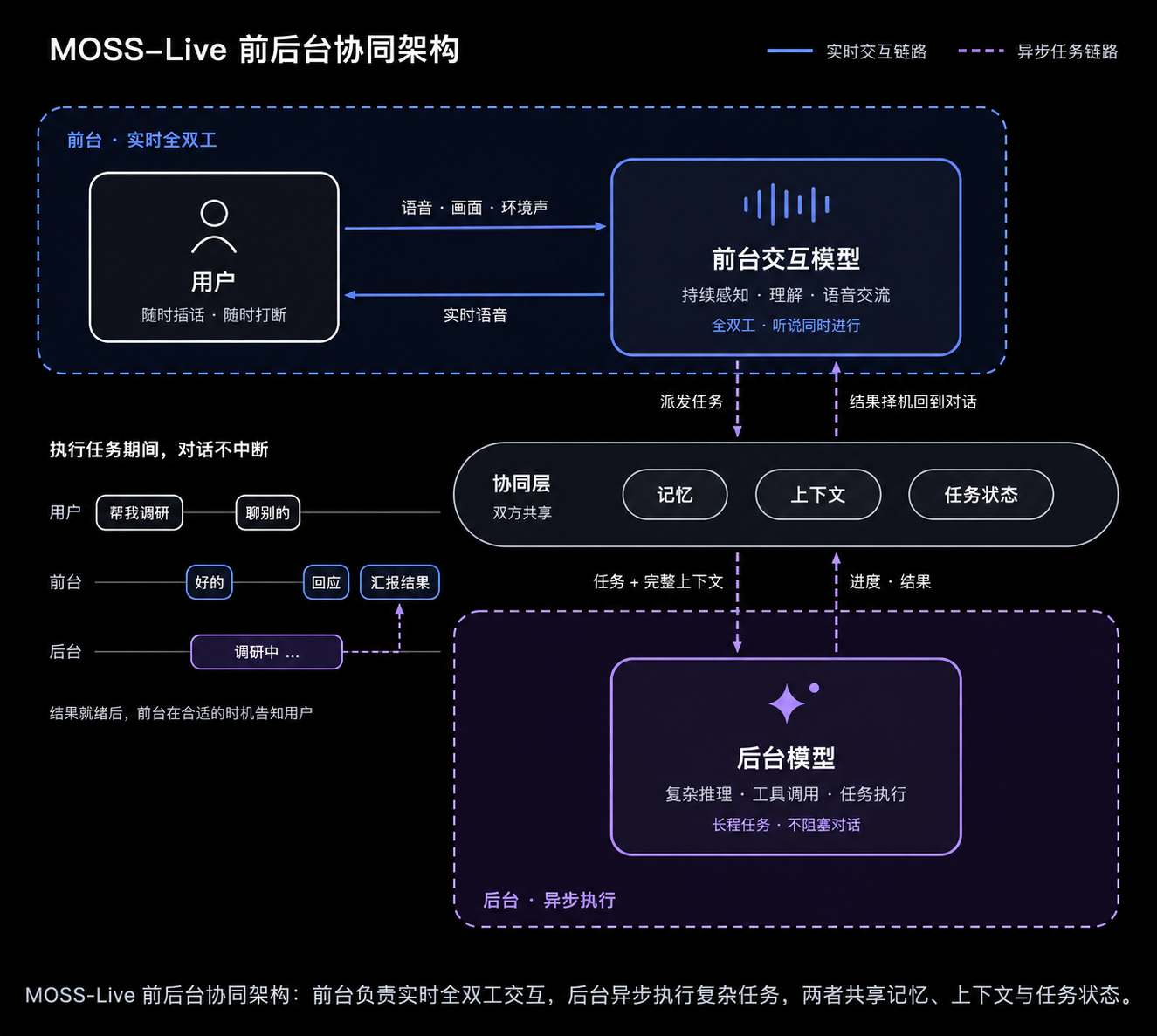
MOSS-Live supports full-duplex speech, semantic interruption, live video and screen sharing, and streaming simultaneous interpretation. Its architecture separates immediate interaction from longer-running work: a foreground model handles ongoing perception and conversation, a background model handles reasoning and tools, and a coordination layer shares memory, context, and task state.
For example, a user planning a trip can ask for a hotel search and then continue discussing itinerary preferences. The search proceeds in the background while the conversation continues; its result returns when ready. This design makes waiting time available for further discussion and lets new requirements accompany an evolving task.
Watch the interaction unfold
The product page provides three demonstrations. Watch for whether an acknowledgment interrupts a response, how a changed request is handled, and how the system returns to an earlier topic. These illustrate behavior; they are separate from the benchmark comparisons above.
A meeting: discussion continues during information retrieval
A road trip: update the plan and return to the conversation
A city walk: use live visual context while talking
Reading the results in context
For applications concerned with false responses in shared spaces, interference while speaking, and recovery after interruption, MOSS-Live deserves close evaluation. For complex multi-turn task completion, GPT-Live-1’s τ-Voice lead remains relevant. For audio-understanding accuracy, Doubao’s Big-Bench Audio advantage also matters.
All results and model labels are transcribed from the MOSS product-page charts accessed on November 13, 2026. These are vendor-published results. The page does not provide sample sizes, uncertainty estimates, API snapshots, or full evaluation settings. Scores from different benchmarks should not be combined into an overall ranking; the irrelevant-speech metrics in FDB v1.5 and τ-Voice are not complementary rates. These results do not establish latency, pricing, or performance in every deployment setting.